
Oligonucleotide manufacturing’s waste problem: the sustainability challenges the field can no longer ignore
Nucleic Acid Insights 2026; 3(8), 611
10.18609/nai.2026.079
Published: 21 October
Infographic
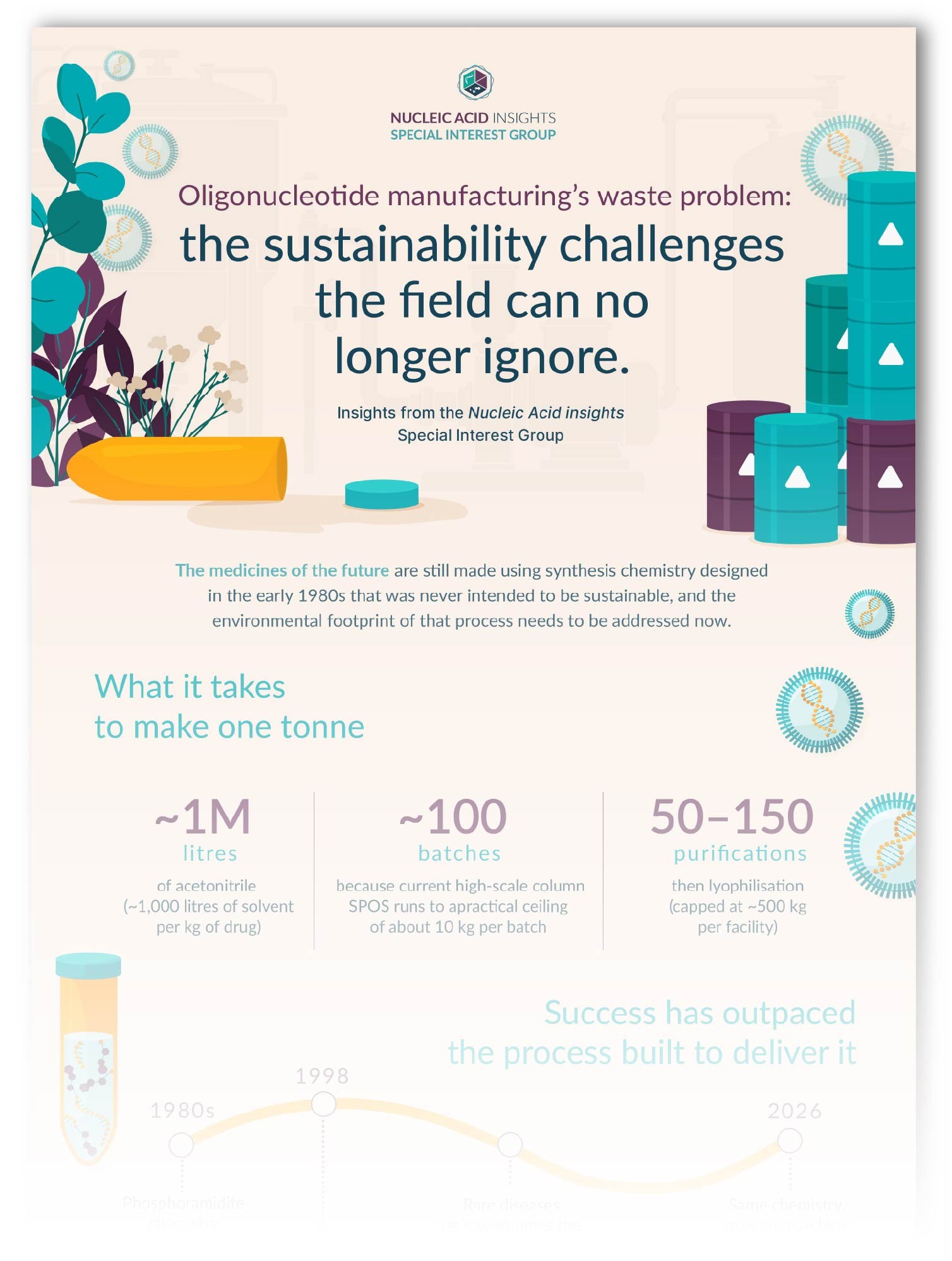
Scaling up oligonucleotides without scaling up waste
Oligonucleotide medicines are approaching mass-market scale, yet they are still made using synthesis chemistry developed in the 1980s. This infographic from the Nucleic Acid Insights Oligonucleotide Manufacturing Special Interest Group (SIG) sets out the scale of the sustainability challenge and the practical steps the field can take now, including:
✓What it takes to manufacture one tonne of oligonucleotide drug✓How synthesis platforms are evolving, from conventional SPOS to liquid-phase, ligation, and biocatalytic approaches✓Why most solvent ‘recycling’ is still downcycling, and what closed-loop recovery requires✓Six priorities agreed by the SIG working groups for cleaner manufacturing at scaleExplore the free infographic below
Scaling up oligonucleotides without scaling up waste
Oligonucleotide medicines are approaching mass-market scale, yet they are still made using synthesis chemistry developed in the 1980s. This infographic from the Nucleic Acid Insights Oligonucleotide Manufacturing Special Interest Group (SIG) sets out the scale of the sustainability challenge and the practical steps the field can take now, including:
✓
What it takes to manufacture one tonne of oligonucleotide drug
✓
How synthesis platforms are evolving, from conventional SPOS to liquid-phase, ligation, and biocatalytic approaches
✓
Why most solvent ‘recycling’ is still downcycling, and what closed-loop recovery requires
✓
Six priorities agreed by the SIG working groups for cleaner manufacturing at scale
Explore the free infographic below