
Industry Insights: Base editing nears its first BLA as AAV safety comes under scrutiny
Cell and Gene Therapy Insights 2026; 12(10), 1059–1064
10.18609/cgti.2026.132
This month, Beam Therapeutics reported positive topline pivotal data for the base-edited autologous cell therapy risto-cel in sickle cell disease, supporting what would be the first Biologics License Application for a base editing therapy [1]. CAR-T therapy in autoimmune disease continued to generate data, with Cabaletta, Fate, and Bristol Myers Squibb reporting one-year and interim results across myositis, lupus, systemic sclerosis, and multiple sclerosis [2–4]. On the regulatory side, the US FDA set out a framework for individualized genome editing products while CMS plans to broaden its access model [10], and the agency opened an investigation into insertional oncogenesis linked to onasemnogene abeparvovec [14]. In this issue: Clinical trials and research Collaborations and partnerships Regulatory changes and updates Market trends |
CLINICAL TRIALS AND RESEARCH |
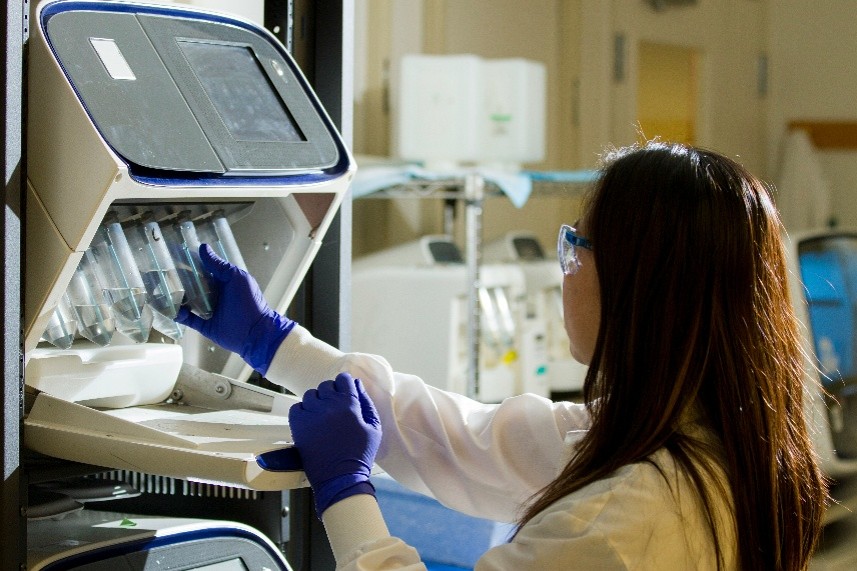 |
Beam reported positive topline pivotal data for risto-cel in sickle cell disease; Clinical trials and research. Credit: National Cancer Institute on Unsplash. |
Beam reported positive topline pivotal data for risto-cel in sickle cell disease [1]
Beam Therapeutics reported that the BEACON Phase 1/2 study of ristoglogene autogetemcel (risto-cel) met its primary efficacy endpoint of freedom from severe vaso-occlusive crises for at least 12 consecutive months, based on independently adjudicated results, and met all primary safety endpoints at a prespecified interim analysis [1]. As of the October 20, 2026 data cutoff, 39 adults and 10 adolescents had been treated and 31 patients had completed the required follow-up. All secondary endpoints were met, including freedom from inpatient hospitalization for severe crises. Risto-cel consists of autologous CD34+ cells base-edited in the HBG1/2 promoter regions to increase fetal hemoglobin. Beam expects to submit a BLA as early as the end of 2026.
Cabaletta presented durable rese-cel responses in three autoimmune diseases [2]
Cabaletta Bio presented Phase 1/2 data for resecabtagene autoleucel (rese-cel), a CD19-directed CAR-T therapy, at ACR Convergence 2026 [2]. All six dermatomyositis patients maintained immunomodulator-free, moderate-to-major Total Improvement Score responses through one year, with five of six reaching that level by Week 16. All five lupus nephritis patients who underwent repeat kidney biopsy achieved remission off immunomodulators and showed histologic response or remission. Five of seven systemic sclerosis patients achieved rCRISS-50 at one year, and the five with interstitial lung disease showed a 9% mean improvement in forced vital capacity. Across 71 patients, 94% had no or Grade 1 cytokine release syndrome and 96% had no ICANS.
Fate Therapeutics reported lupus responses with FT819 given without conditioning chemotherapy [3]
Fate Therapeutics presented updated data for FT819, an induced pluripotent stem cell-derived CD19-targeted CAR-T cell product, at ACR Convergence 2026 [3]. All three extrarenal lupus patients treated without conditioning chemotherapy achieved measurable responses, with two meeting the Definition of Remission in Systemic Lupus Erythematosus and the third reaching Lupus Low Disease Activity State. The first patient to receive two doses had an 8-point reduction in disease activity score at Month 1 and reached Lupus Low Disease Activity State by Month 2, sustained at Month 3. Across 36 patients treated across three regimens and four autoimmune indications, no dose-limiting toxicities were reported. Preclinical data for FT839, a dual CD19/CD38 CAR-T cell product, were also presented.
Bristol Myers Squibb reported Phase 1 data for zola-cel in multiple sclerosis [4]
Bristol Myers Squibb reported interim safety and efficacy data from the Phase 1 Breakfree-2 study of zolacabtagene autoleucel (zola-cel), an autologous CD19-directed CAR-T therapy, in 66 patients with highly active relapsing or progressive multiple sclerosis [4]. Cytokine release syndrome occurred in 42.4% of patients, mostly Grade 1, and 7.6% had immune effector cell-associated neurotoxicity syndrome, including one Grade 4 event. After the data cutoff, one patient developed late-onset motor symptoms that were not attributed to that syndrome and did not resolve with corticosteroids and intravenous immunoglobulin. The patient then received high-dose cyclophosphamide, developed septic pneumonia, and died 44 days after infusion. All 60 patients treated at dose level 2 remained off disease-modifying therapies. Among evaluable patients, 22 of 24 with progressive disease showed stability or improvement in disability progression.
 |
Cleveland Clinic reported triglyceride reductions with CRISPR-based ANGPTL3 editing; Clinical trials and research. Credit: Sangharsh Lohakare on Unsplash. |
Cleveland Clinic reported triglyceride reductions with CRISPR-based ANGPTL3 editing [5]
A Cleveland Clinic Phase 1b trial of CTX310, a CRISPR-Cas9 therapy targeting ANGPTL3, reported an average 63% reduction in triglycerides 30 days after a single intravenous infusion in 10 adults with severe hypertriglyceridemia, with individual reductions of up to 85% and ANGPTL3 levels falling by more than 65% [5]. Non-HDL cholesterol, apolipoprotein B, and triglyceride-rich lipoprotein cholesterol were also lowered. The therapy was generally well tolerated, with no serious treatment-related side effects observed. Findings were presented by CRISPR Therapeutics in a late-breaking session at the American Heart Association annual meeting. The study builds on earlier Phase 1 research across a range of lipid disorders and doses.
Chemogenetic gene therapy reduced seizures in three patients with refractory epilepsy [6,7]
Investigators reported the first use of chemogenetic neuromodulation in humans for drug-resistant epilepsy in the New England Journal of Medicine [6,7]. Three adults with hippocampal sclerosis received an AAV vector carrying the gene for a drug-sensitive receptor, injected into the hippocampus under MRI guidance, followed by low-dose clozapine alongside existing antiseizure medications. Mean seizure frequency fell by 92.6%, and adverse events were Grade 1 or 2. The study was designed primarily to assess safety, was uncontrolled, and did not separate the contribution of the vector from that of clozapine. The vector, GA002, has since received clinical trial clearance from China’s Center for Drug Evaluation and the US FDA.
COLLABORATIONS AND PARTNERSHIPS |
Cordex licensed European commercialization rights for Zemcelpro to Avanzanite [8]
ExCellThera subsidiary Cordex Biologics entered exclusive licensing and supply agreements granting Avanzanite Bioscience commercialization rights to Zemcelpro (dorocubicel) across 32 countries covering the European Economic Area, the UK, and Switzerland [8]. Zemcelpro is a cryopreserved hematopoietic stem cell transplantation product combining UM171-expanded CD34+ cells with unexpanded CD34− cells from the same cord blood unit, conditionally authorized in the EU for adults with hematological malignancies requiring allogeneic transplantation after myeloablative conditioning where no suitable donor is available. Avanzanite will lead regulatory activities, market access, pricing and reimbursement, and distribution, and will hold the EU marketing authorization after transfer. Cordex retains global development, manufacturing, and supply. Terms include development fees, milestone payments, and royalties supporting a planned Phase 3 trial.
Ocugen licensed OCU400 rights for Australia, New Zealand, and ASEAN to Celairis [9]
Ocugen granted Celairis Therapeutics an exclusive license to commercialize OCU400, an investigational modifier gene therapy for retinitis pigmentosa, in Australia, New Zealand, and ASEAN member states, a region of an estimated 725 million people [9]. Ocugen will receive an upfront license fee and potential development and milestone payments of up to $7.1M, including $6.1M linked to the upfront payment and OCU400 topline results, plus a high single-digit royalty on net sales and 50% of gross profits across the territory. Celairis will be responsible for regional regulatory submissions, market access, and commercialization, while Ocugen is expected to manufacture and supply the product. Topline data from the Phase 3 liMeliGhT trial are expected in the first quarter of 2027.
REGULATORY CHANGES AND UPDATES |
 |
FDA issued draft guidance on individualized genome editing products as CMS widened its access model; Regulatory changes and updates. Credit: Sangharsh Lohakare on Unsplash. |
FDA issued draft guidance on individualized genome editing products as CMS widened its access model [10]
The US FDA issued draft guidance, Individualized Human Genome Editing Products: Considerations for BLA Submission and Postapproval Management, setting out a framework for Biologics License Applications covering patient-specific genome editing products [10]. Central to it is the Individualized Feature Space, a set of predefined boundaries within which a product may vary between patients while remaining within a single BLA; variants falling inside those boundaries and supported by adequate in vitro safety and activity data can be added without new clinical trials. The guidance also addresses manufacturing, testing for unintended genetic changes, and naming and labeling. In parallel, CMS will broaden its Cell and Gene Therapy Access Model beyond sickle cell disease.
uniQure’s BLA for ifezuntirgene inilparvovec was accepted with priority review [11]
The US FDA accepted for review uniQure’s Biologics License Application for ifezuntirgene inilparvovec, an investigational gene therapy for Huntington’s disease submitted under the Accelerated Approval pathway, and granted Priority Review with a PDUFA target action date of May 1, 2027 [11]. An Advisory Committee meeting is tentatively planned. The application is supported by 36-month data from the Phase 1/2 study, compared with a propensity score-matched external control derived from the Enroll-HD natural history database. uniQure and the FDA have aligned on a confirmatory study enrolling approximately 200 patients randomized 2:1 against standard of care, with Total Functional Capacity at 36 months as the primary endpoint. US screening is planned by the end of 2026.
Ultragenyx’s marketing application for rebisufligene etisparvovec entered MHRA review [12]
The UK Medicines and Healthcare products Regulatory Agency (MHRA) accepted Ultragenyx’s Marketing Authorisation Application (MAA) for rebisufligene etisparvovec (rebi-vec; UX111; approved by the FDA as FAYUVI in September 2026), an investigational gene therapy for mucopolysaccharidosis type IIIA, on October 28, 2026 [12]. Acceptance confirms the application is sufficiently complete for formal scientific review; the product remains investigational in the UK. Ultragenyx has agreed to schedule the National Institute for Health and Care Excellence (NICE) evaluation alongside the MAA review, aiming for a NICE decision as close as possible to any approval; the NICE Prioritisation Board previously routed the therapy to the Highly Specialised Technology programme. The company announced the start of the EMA Marketing Authorisation Application review the previous month.
Vittoria received RMAT and orphan drug designations for Senza5 CART5 [13]
The US FDA granted Regenerative Medicine Advanced Therapy (RMAT) and Orphan Drug designations to Vittoria Biotherapeutics’ Senza5 CART5 (VIPER-101), a CD5-edited autologous CAR-T therapy for relapsed or refractory CD5-positive peripheral T cell lymphoma [13]. The RMAT designation, which provides enhanced interaction with the agency and potential eligibility for priority review and accelerated approval, was based on clinical data from the Phase 1 VIPER-101 study; Orphan Drug designation was granted in July 2026. VIPER-101 uses the Senza5 platform to generate a dual-population product combining CD5-edited, CD5-directed CAR-T cells with companion CD5-negative, CAR-negative T cells intended to support immune reconstitution, manufactured over five days. Phase 1 results will be presented at ASH in December 2026.
FDA opened an investigation into malignancy risk with onasemnogene abeparvovec [14]
The US FDA reported postmarketing adverse event reports of malignancies in patients treated with Zolgensma, an AAV vector-based gene therapy for spinal muscular atrophy, including confirmed cases of product-related insertional oncogenesis involving the GLI1 oncogene [14]. Reported tumors involved the central and peripheral nervous systems, spinal and paraspinal regions, and kidney. In two of three GLI1-associated cases, molecular analysis showed vector DNA integration with the onasemnogene abeparvovec promoter inserted upstream of or within GLI1. The agency determined that the risk applies to both Zolgensma and intrathecally administered Itvisma, which share the same vector and construct, with no neoplasia reported after Itvisma to date. Benefits continue to outweigh risks while the FDA evaluates whether regulatory action is appropriate.
MARKET TRENDS |
MaxCyte agreed to acquire Akron Bio for $151.8M [15]
MaxCyte entered a definitive agreement to acquire Akron BioProducts from affiliates of Arcline Investment Management for total consideration of $151.8M, comprising $105.0M in cash, approximately $26.8M in shares, and $20.0M in deferred payments due in 2028 and 2029 [15]. Akron supplies GMP-grade reagents and ancillary materials used across the cell therapy manufacturing workflow. MaxCyte expects the transaction to nearly double its revenue base, extend its reach into the viral ex vivo cell therapy market, and support a combined portfolio embedded in five approved therapies and more than 100 clinical programs. MaxCyte also secured a credit facility of up to $75.0M with MidCap Financial. Closing is expected before the end of 2026.
Ultragenyx reported third quarter results and initiated substantial expense reductions [16]
Ultragenyx reported third quarter 2026 total revenue of $173M and a net loss of $118M, and announced headcount and expense reductions intended to deliver at least a 50% reduction in 2027 R&D expenses versus 2025 [16]. The company will cut headcount by approximately 20%, to about 1,000 employees, complete the wind-down of GTX-102 studies in Angelman syndrome, and terminate UX701 for Wilson disease after dose-finding data did not meet criteria to advance to Phase 3. Two priority review vouchers received on approval of the AAV gene therapies GENGLYCOS and FAYUVI are being sold for a combined $413M, with net proceeds of approximately $350M. Ultragenyx reaffirmed guidance for full-year profitability in 2027.
Artiva discontinued AlloNK development and reduced its workforce by 94% [17]
Artiva Biotherapeutics discontinued development of AlloNK (AB-101), its non-genetically modified allogeneic NK cell therapy evaluated with rituximab in rheumatoid arthritis and other B cell-driven autoimmune diseases, and will not initiate the planned Phase 3 pivotal trial [17]. Updated data continued to show deep B cell depletion and clinical activity, but longer-term follow-up did not reach the durability the company required. Two Grade 5 events were reported: a fatal leukoencephalopathy assessed as likely fludarabine-associated neurotoxicity, after which the FDA asked Artiva to pause Phase 2a enrollment and dosing, and a sudden death assessed as unrelated to study treatment. Artiva is reducing its workforce by approximately 94% and evaluating strategic alternatives, with $319.1M in cash and investments.

References
1. Beam Therapeutics Inc. Beam Therapeutics announces positive topline pivotal data from BEACON Phase 1/2 trial of risto-cel in patients with sickle cell disease. Nov 10, 2026.
2. Cabaletta Bio, Inc. Cabaletta Bio presents new rese-cel Phase 1/2 clinical data at ACR Convergence 2026 featuring immunomodulator-free durability and favorable benefit-risk profile across autoimmune diseases. Nov 8, 2026.
3. Fate Therapeutics, Inc. Fate Therapeutics presents new FT819 data at ACR Convergence 2026 highlighting meaningful clinical responses in lupus without the use of conditioning chemotherapy. Nov 10, 2026.
4. Bristol Myers Squibb. Bristol Myers Squibb presents results from Phase 1 Breakfree-2 study of zolacabtagene autoleucel (BMS-986353) in patients with highly active relapsing and progressive forms of multiple sclerosis at MSToronto 2026. Oct 23, 2026.
5. Cleveland Clinic. Gene editing therapy trial dramatically lowers dangerous blood fat levels. Nov 9, 2026.
6. Chemogenetic neuromodulation for refractory epilepsy. N. Engl. J. Med. 2026; 395, 1867–1869.
7. Kountcheva K. Early gene therapy trial for drug-resistant epilepsy shows over 90% seizure reduction. Epilepsy Action Nov 10, 2026.
8. ExCellThera Inc. Zemcelpro® (UM171 Cell Therapy) licensing and supply agreements announced for Europe. PR Newswire Nov 9, 2026.
9. Ocugen, Inc. Ocugen and Celairis Therapeutics enter into exclusive license agreement for OCU400 in Australia, New Zealand, and ASEAN. GlobeNewswire Nov 10, 2026.
10. US Department of Health and Human Services. FDA and CMS announce new steps to advance gene therapies and expand access for patients with rare diseases. Oct 27, 2026.
11. uniQure N.V. uniQure announces FDA acceptance and priority review of the Biologics License Application for ifezuntirgene inilparvovec for the treatment of Huntington’s disease. GlobeNewswire Nov 2, 2026.
12. Ultragenyx Pharmaceutical Inc. Ultragenyx announces the Marketing Authorisation Application (MAA) for its investigational gene therapy for MPS IIIA (Sanfilippo syndrome Type A) is under review with the UK Medicines and Healthcare products Regulatory Agency (MHRA). GlobeNewswire Nov 6, 2026.
13. Vittoria Biotherapeutics, Inc. Vittoria Biotherapeutics announces FDA RMAT and orphan drug designations for Senza5 CART5 (VIPER-101) in T cell lymphoma. GlobeNewswire Nov 10, 2026.
14. US Food and Drug Administration. FDA investigating serious risk of malignancy linked to Novartis’ Zolgensma gene therapy. Nov 6, 2026.
15. MaxCyte, Inc. MaxCyte to acquire Akron Bio, expanding its offerings across cell therapy manufacturing and expecting to nearly double revenue base. GlobeNewswire Nov 10, 2026.
16. Ultragenyx Pharmaceutical Inc. Ultragenyx reports third quarter 2026 financial results, announces substantial expense reductions, and reaffirms profitability in 2027. Nov 3, 2026.
17. Artiva Biotherapeutics, Inc. Artiva Biotherapeutics announces strategic update and discontinues development of AlloNK®. GlobeNewswire Oct 27, 2026.