Founder’s perspective: a conversation with Elisa Manzotti on 10 years of Cell & Gene Therapy Insights
Cell & Gene Therapy Insights 2025; 11(9), 1223–1227
DOI: 10.18609/cgti.2025.141
Founder’s perspective
On 10 years of Cell & Gene Therapy Insights
As Cell & Gene Therapy Insights celebrates its tenth anniversary, Abi Pinchbeck (Editor, BioInsights) speaks with Elisa Manzotti (Founder of BioInsights) about the journal’s origins, challenges, and evolution as an open access, digital, and translationally focused publication. Elisa reflects on the lessons she has learned about collaboration and quality, the importance of adding value in an increasingly crowded publishing landscape, as well as the joy of putting on her “science-geek hat”.

When you look back to the launch of Cell & Gene Therapy Insights ten years ago, what were your initial hopes and visions for the journal?
During the early stage of my career in STEM publishing, the field was all about print subscriptions—and getting more out of diminishing academic librarian budgets every year. Great content was being published behind a paywall, and no one was actually able to read it.
I felt that there were so many better ways to approach publishing. I thought it was the right time to take advantage of an ever-increasing number of digital platforms and technology. The speed with which you can get new research and information online is remarkable, especially without having to worry about compiling a print edition. Additionally, exploring the open access business model was, for me, incredibly important to ensure we could provide access to the community for free while supporting it through alternative revenue streams.
Meanwhile, my absolute passion for the CGT space cemented the idea. It has always been an area that have I loved since I launched Regenerative Medicine at the start of my editorial career. It is such a welcoming, exciting community to work within. When I spoke to a few of my friends and colleagues who are experts in the field, there was a resounding noise of support about our launch, especially as there had been the emergence of exciting CAR-T cell therapy clinical data showing remarkable efficacy in patients at that time. The convergence of cell therapy and gene therapy was truly rejuvenating the space—with a great deal of investor confidence, but also huge challenges and hurdles ahead regarding manufacturability and tackling larger disease groups, as well as the rare diseases where these therapies were seeing success.
It felt like we could add a lot of value by positioning ourselves as a translational-focused journal. Basic research was already well covered in other publications and had lots of exciting developments, but addressing the challenges the sector was facing to make these therapies clinically and commercially viable was just as important. That, for me, was where it made sense to establish ourselves and provide a valuable content and discussion platform for that space.
I have always tried to ensure that we are adding value, not just noise. That has always been my approach as an editor: add value with the content you provide because people are busy and need a good reason to stop in their day and read your content, watch your webinar, or listen to your podcast.
Can you share a memorable moment or a challenge from the early days of launching the journal?
There were quite a few memorable moments, but certainly more challenges at the outset. Even though I had a good network of people in the cell therapy space, BioInsights was still a brand-new, relatively unknown publishing company. Much of the early work was arranging calls and meeting with people who were active in the space to understand how to shape the content.
There is a real danger if you only do desk research and assume you know what the community needs. You must go out there, ask the right questions, and understand the key pain points and challenges from those who face them day-to-day. Much of those early months involved knocking on as many doors as possible and speaking to as many people as I could to help shape the editorial calendar, ensuring that we were providing content that truly resonated with the community.
Another big challenge at the outset was running very lean. You become a bit of a jack-of-all-trades—I was teaching myself HTML coding for our first website, commissioning content, editing, and being a marketing manager at the same time. The early days were all about getting as much content online as possible to build the audience as quickly as possible.
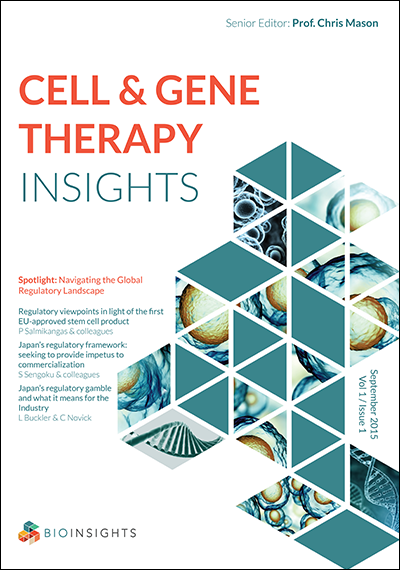
The early goals were to build a reputation, gain trust as quickly as possible, and be seen by the community. As for memorable moments, I will never forget the slightly egotistical process of getting some of the launch issue printed purely for myself to be able to hold something tangible and show it to my parents!
Do you still have it?
I do—my mum recently sent me a photo of me with the launch issue of Cell & Gene Therapy Insights in print. I absolutely love it and was so proud in that moment. It is harder with online publishing to get that sense of achievement once you click ‘publish’, versus holding the print copy, smelling the paper—it is lovely. I may one day frame it and attribute it to all my gray hairs.
There were many memorable moments after that, especially when I started attending events in the sector and we launched initiatives such as the Translational Pioneer Award, which we awarded to Professor Carl June one year, and Professor Maria Roncarolo another. I felt so privileged to meet people who were utterly transforming the face of modern medicine, yet were so humble and collaborative. Those are the moments where I would feel genuinely giddy, which really captures those early days.
From a strategic and business perspective now, what were some of the key hurdles?
It was crucial to be as clear as possible about the niche approach we were taking. I wanted to make it obvious that we were differentiating ourselves by focusing on the translational piece of the puzzle. This meant that having the right editorial advisory board and contributors from industry was key.
Having come from a much more traditional academic STEM publishing background, it was the norm to generally not engage with the industry because it would not get you an impact factor, and that was the metric you were supposed to care about. But that wasn’t our business model. If you exclude the industry from the discussion because it is too commercial, then you are missing a huge and essential part of the conversation. Early on, I wanted to foster those relationships, gain their input, and help them feel that this was a publication and a community for them, too.
Considering the CGT space was abuzz with excitement, investment, and possibility, it was a wonderful time to engage with it and move quickly. It was also critical to respond rapidly when new topics, challenges, or exciting data emerged, and to ensure our editorial calendar reflected that.
For me, it was also about ensuring sustainability—meeting the needs of our clients and, in addition to being a trusted scientific publisher, building our reputation as a trusted partner in content marketing. It was about attending events, visiting clients’ offices, chatting about their pain points in reaching their target audience, and co-creating exciting, valuable content with them. This approach has helped cement many of our long-term partnerships with clients.
What do you think sets Cell & Gene Therapy Insights apart from other journals in the field?
I wanted to carve out our niche in the translational space. Even though I love much of the basic research side of science, I love nothing more than seeing how it translates into actual changes in healthcare and outcomes for patients with really devastating diseases. That, for me, was how we were going to differentiate ourselves from the rest of the publishing landscape and serve a genuine need.
It was also about ensuring as many people as possible could access that content—that it was not hidden behind a paywall and that we commissioned the content ourselves. By the time the open access movement had fully arrived, the landscape of journals had become oversaturated. It was difficult for researchers to differentiate between reputable journals and those that were simply trying to generate a new revenue stream with minimal quality underpinning their publication practices.
I did not want to run large calls for papers; instead, the focus was on ensuring the quality of our content so that our audience could trust it. That comes from conducting the research, finding the right people to speak to, and personally inviting them to contribute and implementing a rigourous peer review process. I think that is what truly sets us apart from other platforms and publications, in an era of somewhat crowded open access publishing.
What lessons have you learned about scientific publishing that you think are especially relevant in today’s digital and open access era?
I learnt to not shy away from involving big pharma and biotech companies in the discussion. There is a huge number of amazing scientists and researchers within those industries who have valuable insights to share. Particularly at the outset of starting the journal, it was wonderful to see how collaborative people were. They shared real-world challenges, especially around the manufacturability of CGTs.
Beyond that, the key lesson I have learned about scientific publishing is that you must add value. There must be quality, and it must be obvious. In today’s environment, where people are constantly bombarded with online content and are feeling more time poor than ever, it is crucial to find ways to demonstrate value and quality, even in shorter formats. It also is essential for us to keep abreast of trends in content consumption; we need to be aware of how people engage with content and innovate around that as well. We are focused on new product development within BioInsights, and a large part of that involves understanding how our audience wants to consume their content and making sure we meet those needs with innovative formats and channels.
What has been the most rewarding part of your journey with Cell & Gene Therapy Insights?
The fact that our publication is trusted and utilized by the cell and gene therapy community is incredibly rewarding. When I think about the early days, I can visualize myself in my living room at midnight, coding on our WordPress website to get that first launch issue live. It feels like a lifetime ago, yet I can still picture it vividly. Seeing how far we have come, I occasionally allow myself moments of pride.
We receive a lot of incredible feedback—from our advisory board, webinar attendees, authors, and peer reviewers. People appreciate our personal touch, which, first and foremost, was very much ingrained in how I wanted to do this. From the outset, I wanted engagement with us to feel as personalised as possible. For instance, if someone has kindly agreed to speak on one of our webinars, they feel supported throughout the process, from preparing for the panel discussion to going live.
Much of our feedback revolves around how enjoyable it is to work with our team and how supported people feel, which, for me, is incredibly important. There have been so many rewarding moments. I have thoroughly enjoyed building up this business, and we have a wonderful group of people in the company with whom it is a pleasure to work. I feel very lucky to love what I do and so much of that is down to the great team I work with and our commitment to retain the mentality of a start-up even as we continue to scale. It makes for a very dynamic, fast paced environment!
I also feel very fortunate to work with so many people in the sector, to speak with them, and to learn from them, because it is such an exciting space. Being able to still put on my science-geek hat is very gratifying at this stage in my career.
And here is the launch issue cover of Cell & Gene Therapy Insights, published in September 2015: